Nexen Tire set a quarterly revenue record of $613 million in Q2, driven mainly by European expansion, premium OE fitments and a growing mix of 18-inch-and-larger tires.
Higher raw-material and freight costs and non-recurring U.S. anti-dumping expenses pushed operating profit down 19.5%, while lower non-operating income and a one-time deferred-tax charge at Nexen’s European subsidiary nearly eliminated net profit. The report shows strong product and production momentum, but also puts pressure on Nexen to turn its North American distribution investments and expanding OE presence into stronger replacement-tire sales.
Nexen’s financial report shows its production and premium-product strategies are generating sales, particularly around its Czech plant and expanding OE portfolio. The less settled part of the business is North American replacement distribution, where revenue and large-diameter tire mix both declined during the quarter, even as Nexen worked to strengthen retail partnerships and made inventory adjustments following customer transitions.
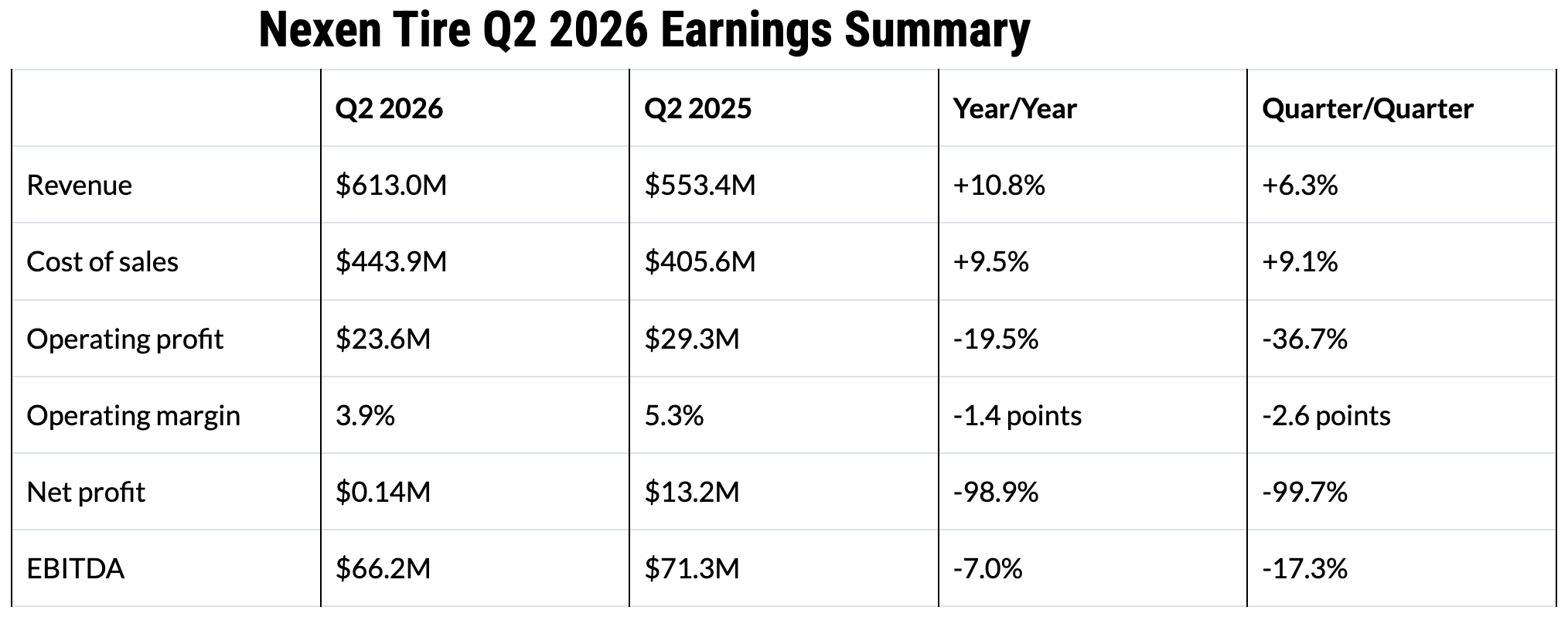
All U.S. dollar figures are approximate and use KRW 1,454 to $1, the exchange rate implied by Nexen’s July 29 release. First-half totals and growth comparisons are Tire Review calculations using Nexen’s quarterly results.
Sales Set Another Record, but Profit Moved the Other Way
The KRW 891.3 billion second-quarter result surpassed the KRW 838.3 billion, or approximately $576.5 million, record Nexen reported in the first quarter. Revenue increased 6.3% sequentially and 10.8% from Q2 2025, marking another step up after the company first crossed KRW 3 trillion, approximately $2.06 billion, in annual revenue last year.
Across the first half, Nexen generated KRW 1.73 trillion, approximately $1.19 billion, in revenue. That was up 9.8% from the combined first two quarters of 2025. First-half operating profit totaled KRW 88.5 billion, approximately $60.9 million, up 6.2%, but the operating margin slipped to approximately 5.1% from 5.3%.
Tires 18 inches and above accounted for 38.8% of Q2 sales, up 3.6 percentage points year over year, as premium OE fitments and larger sizes continued to expand.
The sales increase did not come from a broadly expanding tire market. In its Q2 earnings presentation, Nexen estimated that global new-vehicle sales fell 4% in Q2, global passenger-car and light-truck OE tire demand was down 4% through six months, and replacement demand was flat.
That makes Nexen’s growth more closely tied to its own production ramp-up, OE additions, distribution expansion and regional product strategy.
Why Operating Profit Fell Even as Sales Grew
Cost of sales increased 9.5% to KRW 645.5 billion, approximately $443.9 million. Because revenue grew faster, the cost-of-sales ratio improved to 72.4% from 73.3% a year earlier. It nevertheless worsened by 1.8 percentage points from the first quarter as raw-material and freight pressure intensified.
Gross profit rose approximately 14.3% to KRW 245.8 billion, or approximately $169.1 million, but selling, general and administrative expenses increased 22.8% to KRW 211.5 billion, approximately $145.5 million. SG&A consumed 23.7% of revenue, compared with 21.4% a year earlier.
The company attributed the operating-profit decline to higher rubber and ocean-freight costs following the Middle East conflict, a one-time adjustment after the final U.S. anti-dumping duty rate came in above the preliminary rate, and a product-mix shift caused by weaker performance in higher-priced markets and increased OE volume.
In other words, Nexen sold more tires and generated more gross profit, but the combination of cost pressure, trade expense and operating spending left less profit at the operating line.
Why Net Profit Nearly Disappeared
The sharpest number in the report was net profit of only KRW 0.2 billion, or approximately $140,000. That was down 98.9% from KRW 19.2 billion, approximately $13.2 million, a year earlier and 99.7% from KRW 62 billion, approximately $42.6 million, in the first quarter.
That bottom line should not be read as a measure of tire operations alone. Nexen recorded a KRW 6.5 billion, approximately $4.5 million, non-operating loss after posting KRW 25.5 billion, approximately $17.5 million, in non-operating profit in Q1. It cited lower gains on financial assets, lower foreign-exchange gains and fewer other non-operating gains.
Income-tax expense then rose 220% year over year to KRW 27.6 billion, approximately $19 million, nearly matching profit before tax. Nexen said the increase primarily reflected a non-recurring deferred-tax liability recognized at its European subsidiary.
That accounting charge, combined with the weaker operating result and non-operating loss, explains why net profit fell much more sharply than revenue or operating profit.
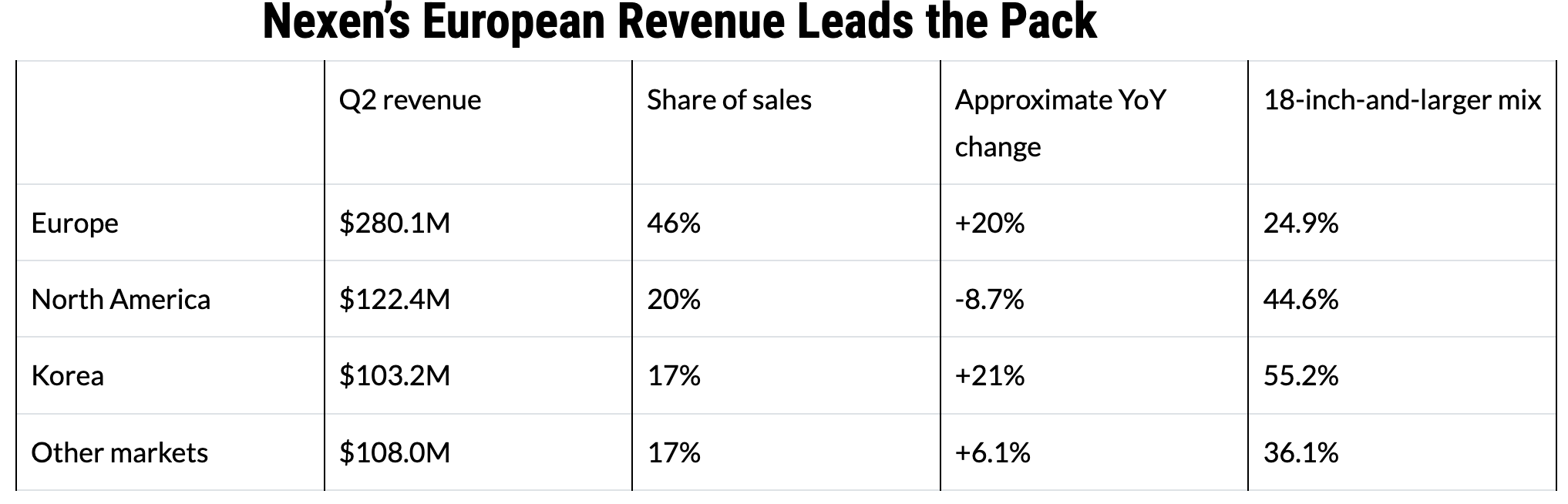
Regional figures are rounded in Nexen’s presentation and may not sum exactly to consolidated revenue. Year-over-year changes are calculated from the rounded regional values.
Europe accounted for nearly half of Nexen’s quarterly revenue. Sales reached KRW 407.2 billion, approximately $280.1 million, up about 20% from a year earlier and above KRW 400 billion for the first time. OE growth came from programs with automakers including Stellantis and Audi, while replacement sales expanded through the U.K., Russia and Türkiye.
The result also puts more weight behind Nexen’s Czech investment. The second phase of the Žatec plant has helped raise Czech production capacity from 50,000 metric tons in 2023 to 90,000 metric tons in 2026. Across four plants in Korea, China and the Czech Republic, Nexen lists total capacity of 480,000 metric tons.
The company also expanded its finished-goods operation at Žatec. As Tire Review reported in June, a new automated warehouse increased storage capacity approximately 57%, from 530,000 to 830,000 tires.
That gives Nexen more room to hold seasonal inventory closer to European customers and move the additional Phase 2 output through local distribution.
Nexen Reworks China Sourcing Ahead of EU Duties
Nexen has also changed how it supplies Europe in response to the European Union’s anti-dumping investigation into Chinese passenger-car and light-truck tires. The company said the provisional duty was 29.9% and listed the final rate announced in July at 24.4%. It reduced the share of European sales sourced from its Chinese plant from 15% in 2025 to approximately 4% in 2026.
The company said China-made volume previously destined for Europe is being redirected to China’s domestic market and other export markets. Nexen also implemented a 5% price increase in Europe effective in June to help offset the tariff impact.
The combination of a lower final rate, reduced China sourcing and higher pricing should limit direct exposure, but it does not eliminate the raw-material and freight costs that pressured Q2.
Nexen expects lower European market inventory, along with higher-value winter and all-weather tire sales, to support earnings. The hope for Nexen is whether the Czech plant can convert its higher output and improved logistics into stronger margins rather than sales growth alone.
Nexen Targets North American Growth
North American revenue fell approximately 8.7% year over year to KRW 178 billion, or approximately $122.4 million, representing 20% of Nexen’s sales. OE business remained resilient through pickup and SUV programs despite weaker vehicle sales, but replacement volume declined as the company expanded its customer base in a weak, highly competitive market.
Nexen said performance was affected by weak consumer sentiment, inventory buildup in low-cost distribution channels and its own inventory adjustments following customer transitions.
The regional share of 18-inch-and-larger tires also slipped to 44.6% from 45.7% a year earlier and 48.8% in Q1. That contrasts with the company’s global increase in large-diameter mix.
Nexen plans to expand retail partnerships, including Walmart, deepen wholesale relationships, add regional customers and increase UHP and 18-inch-and-larger offerings. It is also investing in store-level marketing, distribution-specific products and its Next Level dealer program.
In July, Nexen lowered the program’s Tier 1 quarterly threshold from 100 eligible units to 60 for Q3 and Q4. A new Guelph, Ontario, warehouse is intended to improve Canadian availability and lead times.
Korea and Other Markets Add Growth
Korean revenue increased about 21% to KRW 150 billion, approximately $103.2 million. The region had Nexen’s richest large-diameter mix: tires 18 inches and above accounted for 55.2% of sales, up 7 percentage points year over year.
The company credited EV and SUV OE sales, replacement growth through major retailers, new product launches and continued expansion of its tire-rental business.
Nexen’s domestic OE portfolio includes the Hyundai IONIQ 6 and Kia’s EV3 through EV9. Despite production disruptions at automakers, the company said EV and SUV programs supported OE revenue while rental growth and additional sales partnerships improved the replacement mix.
Revenue from other markets rose approximately 6.1% to KRW 157 billion, or approximately $108 million. Nexen cited its first OE business with BYD, stable supply to major automakers, new customers in Asia-Pacific and Latin America, and a partial recovery in Middle East shipments after the temporary reopening of the Strait of Hormuz.
Premium OE Sales Rise 80%
Nexen said first-half sales to four major premium automakers increased 80% year over year. New second-quarter programs listed in the presentation included the BYD Seal 6 and Dolphin Surf battery-electric vehicles, the Hyundai Staria EV, the Audi A6 with an internal-combustion powertrain and the BMW i3 battery-electric vehicle.
Those programs extend a run of OE announcements Tire Review has covered, including the BMW iX3, Kia Seltos in North America and Europe, and 2026 Jeep Cherokee hybrid.
Nexen said AI-based tire-performance prediction and virtual development are helping it meet requirements for premium and electrified vehicles.
Raw Materials and Freight Remain the Cost Risk
Nexen’s Q2 statement didn’t offer a reason to assume the cost pressure will disappear quickly. Natural rubber prices increased during Q2 despite the end of the wintering season, partly because buyers substituted natural rubber for higher-priced synthetic rubber.
The company said it sees continued second-half volatility from early purchasing in China and weather conditions in Thailand and Indonesia.
Synthetic-rubber prices declined after April as demand slowed and inventories increased, but Nexen said renewed Middle East tension could push oil and feedstock costs higher again.
Ocean freight is another variable. The Shanghai Containerized Freight Index exceeded 3,000 points for the first time in approximately 25 months as oil prices rose and shippers moved cargo early ahead of major retail events and tariff uncertainty.
Nexen expects container-vessel oversupply to persist over the medium to long term, which could eventually help rates. For the second half, however, it warned that geopolitical risk could delay freight stabilization.
That leaves pricing, product mix and local production as the company’s main near-term tools for protecting margin.
What Nexen’s Full-Year Guidance Now Requires
The Q2 presentation did not include an updated full-year forecast. In its February earnings presentation, Nexen guided to more than KRW 3.3 trillion, approximately $2.27 billion, in 2026 revenue, approximately 3.5% growth, and a high-single-digit operating margin.
First-half revenue of KRW 1.73 trillion, approximately $1.19 billion, represents approximately 52% of the sales target, putting the top line on pace. The first-half operating margin of approximately 5.1%, however, sits below the full-year goal and requires a meaningful second-half improvement.
Nexen is counting on stable operation of the second-phase Czech expansion, lower European channel inventory, winter and all-weather demand, its June price increase and the North American distribution overhaul to close that gap.
“Despite growing cost pressures from external factors, we have continued to achieve top-line growth on the back of strong sales in key markets,” said John Bosco (Hyeon Suk) Kim, CEO of Nexen Tire. “With the stable ramp-up of the second-phase expansion at our European plant and the results of our distribution improvements in North America, we expect more tangible improvements in earnings.”
What Tire Dealers Should Take From the Report
Nexen is selling more tires in a flat-to-declining global market, and Europe shows that added production, premium OE programs and local warehousing can work together.
But the 3.9% quarterly operating margin shows how quickly tariffs, freight, materials and channel costs can absorb those gains.
In North America, dealers should expect a more visible push around retail partnerships, large-diameter and UHP products, local marketing and the Next Level program. The strategy is aimed at improving sell-through and moving Nexen farther downstream rather than relying only on imported volume.
The decline in regional revenue and large-diameter mix shows that work is still in progress. The longer-term opportunity is the connection between OE credibility and replacement demand. Nexen’s premium and EV fitments are growing quickly, but the financial payoff depends on converting those vehicle placements into replacement sales with the right products, inventory and dealer support.